


.svg)
.svg)
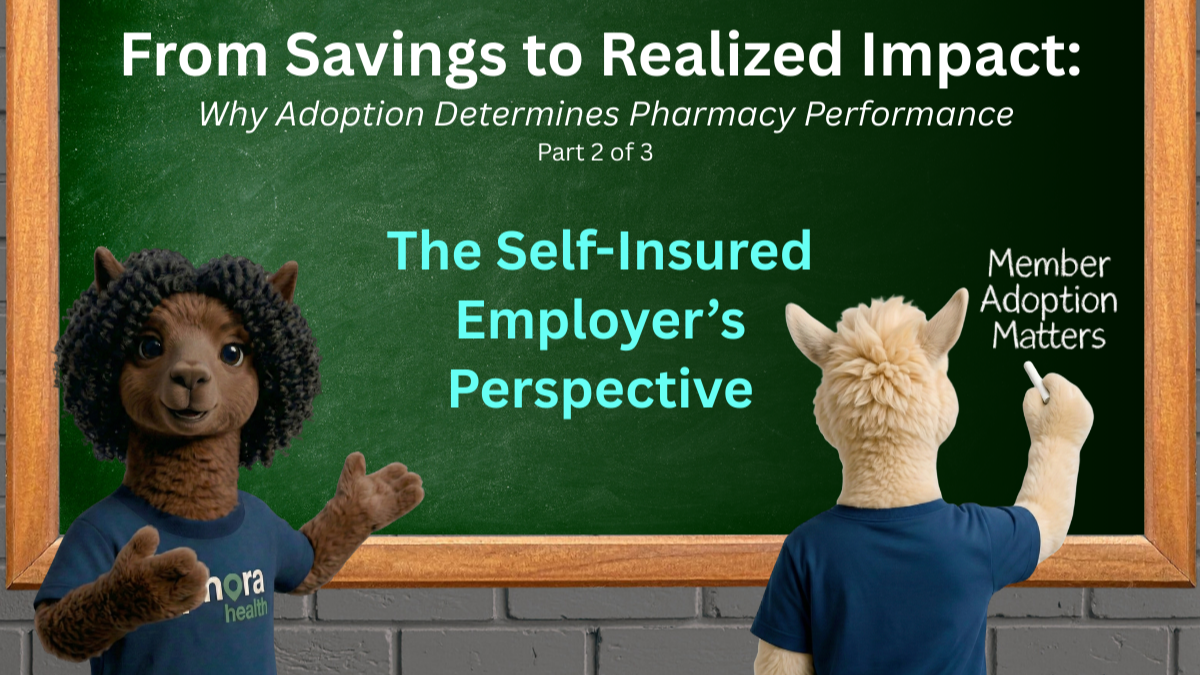
In Part I, we established that projected savings do not equal realized impact. Modeled reductions in unit cost create opportunity, but it is employee adoption determines whether that opportunity becomes financial performance.
Part II examines that gap, what I call the “last and longest mile,” from the employer’s perspective.
Every self-insured employer reviewing pharmacy cost management proposals is presented with compelling projections. Specialty cost compression is modeled, generic optimization is illustrated, the structure appears disciplined… The math seems to work. Ok! Awesome. Let’s go!
But, as we know, projected savings do not appear on an income statement simply because a contract is signed. They materialize only when eligible employees enroll, migrate prescriptions into the optimized pathway, and remain engaged over time. If migration is slow, incomplete, or inconsistent, claims remain in legacy channels. Higher-cost fulfillment persists. Generic capture underperforms. The modeled economics begin to drift from operational reality.
This is where many strategies lose momentum.
The pricing architecture may be well designed. The sourcing discipline may be strong. But performance ultimately depends on execution at the point of conversion. How effectively are employees educated? How frictionless is enrollment? How quickly do prescriptions migrate? How consistently are members supported through refill cycles?
Employers are often left asking why realized savings lag expectations, even when pricing appears favorable. The answer is rarely price alone. It is adoption velocity, migration rate, and sustained engagement.
Employers should evaluate pharmacy strategy through an operational lens, not just a financial one. What percentage of eligible employees migrate within the first 90 days? What is the time to first fill? What retention rate is sustained at six and twelve months? How are realized savings measured against projections? How frequently are results reported and reconciled?
Adoption is not a secondary metric. It is a core KPI that determines whether a savings architecture produces durable financial impact.
There are also longer-term implications. When employees experience a seamless transition, trust builds, refills remain consistent, and engagement stabilizes. That stability strengthens renewal conversations and supports multi-year value creation. When experience falters, even well-priced programs can struggle to retain credibility.
Financial discipline remains essential. Cost structure must be engineered carefully. But disciplined sourcing alone does not guarantee performance. The full equation includes unit cost optimization, migration rate, retention durability, and transparent measurement of realized savings.
Employers absolutely deserve clarity around what is modeled and what is achieved. Adoption is the bridge between the two.
At Aphora Health, we integrate structured Pharmacy Savings Architecture with a deliberately designed Member Experience model that drives enrollment, migration, and sustained engagement.
We measure performance not only by projected opportunity, but by realized savings delivered over time and reported transparently. We work alongside brokers and employer partners to educate employees, remove friction in the transition process, address concerns directly, and actively monitor conversion performance.
In Part III, we will examine the role brokers and benefits advisors play in shaping adoption performance across employer portfolios and why accountability must be embedded before a strategy ever reaches an employer.
If you are evaluating pharmacy strategy and want clearer visibility into how modeled savings convert into measurable financial outcomes, we welcome the conversation. Feel free to schedule a time that works for you: https://aphorahealth.com/contact-us